- The Varato Letter
- Posts
- Rewiring the Enterprise to Become AI Native with Melissa Reeve
Rewiring the Enterprise to Become AI Native with Melissa Reeve

Rich Barker
November 24, 2025

Welcome to The Varato Letter, Sponsored by Harris Web Works.
Every Saturday, we share insights with 1,100+ supply chain leaders on modernizing business operations for the digital age. This newsletter will be Free for the reader forever. Enjoy!
To learn more about how Harris Web Works can help you to future proof your manufacturing wholesale or distribution business, click here.
This week on the Varato podcast, host Matt Harris spoke with Melissa Reeve, founder of Hyper Adaptive Solutions and former VP of Marketing at Scaled Agile, Inc., about the critical shift organizations must undergo to embrace the AI revolution, a concept she explores in her upcoming book, Hyper Adaptive: Rewiring the Enterprise to Become AI Native.
🧠 From Linear to Hyper-Adaptive: The AI Native Enterprise
Reeve's book is premised on the idea that most organizations are "linear organizations," characterized by layers of hierarchy from strategy to execution, and handoffs and delays from concept to delivery.
The hypothesis is that AI will "compress" both these dimensions. AI-native organizations start off naturally compressed, and for those that aren't, Hyper Adaptive Solutions proposes a five-stage model to incrementally and iteratively shift the organization into a more AI-native space. This transition requires a complete "rewiring" of communications, roles, people, and processes.
Understanding "Compression": Reeve uses a marketing example, like creating an e-book, to explain compression. The process typically involves handoffs between designers, copywriters, and reviewers. AI smoothes this out by enabling more people to handle more parts of the process—for example, AI assisting with copy editing, graphics, or layout.
🛑 Why AI Initiatives Struggle
Discussing a report on the low return on investment for enterprise AI initiatives, Reeve offered several reasons for high failure rates:
The J-Curve Effect: When AI is introduced, there is often a "learning curve" where people slow down before they speed up as they learn the capabilities and how to interact with the new tools. Current negative headlines often reflect this J-curve.
Lack of Deliberate Rollout: Organizations are not being deliberate enough about AI rollout and are failing to provide necessary support structures to embed AI into day-to-day processes and roles.
Social Learning: Since AI learning is social, companies need to put deliberate structures in place—like "AI Fridays" or "prompting parties"—to encourage social contagion and the systematic adoption of new behaviors.
Lack of Focus: Many pilots fail because they are not focused, choosing random things to automate that may not align with business goals, pain points, or areas where the company can "really move the needle".
🎯 The F.O.C.U.S. Framework for Prioritization
To avoid "random acts of AI" and mitigate the failure rate, Reeve proposes the F.O.C.U.S. framework for prioritizing AI use cases:

Fit: Is the initiative aligned with a strategic goal? (e.g., Moderna's goal to develop 15 drugs in five years) .
Organizational Pull: Is this addressing a personal pain point, or a collective, high-friction problem for the organization (like scheduling meetings)?.
Capability: Do we have the ability to execute this? Reeve raises the concept of "junior IT," where non-IT staff can build automations using elevated IT skills.
Underlying Data: Is the necessary data clean, accessible, and sufficient to support the AI solution?.
Success Metrics: Are you clear on how to measure success, whether through ROI, quality, or time-to-market?
💡 Leadership and the New Assembly Line
Reeve drew parallels between the AI revolution and historical shifts like factory automation and the internet revolution, emphasizing that while the pace of change is rapid, it is not an overnight sprint.
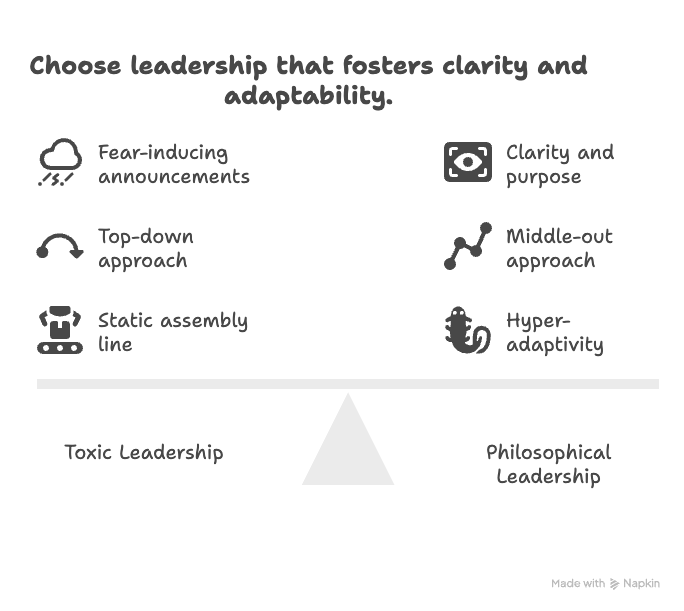
Toxic vs. Philosophical Leadership: Toxic leadership announces fear-inducing job cuts without clarity ("slash 12,000 jobs because of AI"). Helpful leadership, conversely, develops a philosophical stance—asking why the company is doing AI (e.g., to improve customer experience, grow the company, or preserve relationships).
The Power of Middle Out: Change management in large organizations requires a "middle out" approach. Middle managers are crucial because they tie the strategic intent (like Moderna's 15 drugs goal) to the "operational reality of the constraints on the ground".
Hyper-Adaptivity is the New Assembly Line: The ultimate goal is hyper-adaptivity—the ability to continuously sense, learn, and respond. This involves continuous learning loops, where organizations use AI to test dozens of scenarios (A to infinity testing) and ingest that data back into the system. This continuous process of innovation and learning is the modern equivalent of the assembly line.
Reeve stressed that because jobs are made of tasks, processes, decisions, and human interactions, the future will involve deconstructing and remixing jobs, not wholesale elimination. The focus should be on making existing staff more impactful, effective, and satisfied.
Melissa Reeve's book, Hyper Adaptive, will be released in the spring through IT Revolution.
Would you like to know more about the concept of "middle out transformation" for enterprises?
Whenever you're ready, here's how we can help you:
Harris Web Works is a digital transformation agency that helps supply chain partners (manufacturers, wholesalers & distributors) meet new generational buyer demands & expectations by installing streamlined e-commerce systems.
To learn more about how we can help you future-proof your business, click here.